




Special Educational Needs and Disabilities (SEND)
SEN Information Report
The purpose of the information report is to inform parents and carers about how we welcome, support and make effective provision for children with special educational needs and/or disabilities (SEND). We are committed to providing equal learning opportunities for all our children regardless of race, gender, special educational needs and / or disabilities (SEND). We are part of the Extend Learning Academies Network (ELAN) and some of our policies that support this document are adopted from ELAN and some are school specific.
This report describes Oldmixon Primary School's provision for people with SEND. The report has been produced in accordance with the Special Educational Needs and Disability (SEND) Code of Practice and information has been included in line with the Special Educational Needs and Disability Regulations 2014 Schedule 1.
This report is the responsibility of the SENDCO
The report was reviewed and updated: October 2025
This report due for final approval by the school governing body on: 2 February 2026
This report will be kept under review throughout the academic year. Where amendment is necessary due to operational or staffing changes that do not materially affect the nature of the support, the report will be updated by the SENDCO.
SENDCO: Lindsay Avci
Email: lindsay.avci@oldmixon.extendlearning.org
Telephone 01934 812879. Oldmixon Primary School, Monkton Avenue Weston-super-Mare BS24 9DA
Headteacher: Corinna Rundle-Crowe
SEND Link Governor: Laura John
At Oldmixon Primary School, we recognise each child as a unique individual with his or her own personal talents, experiences, learning styles and needs. We value their abilities and achievements, and are committed to providing an effective learning environment which promotes their intellectual and personal development. We are an inclusive school - we wish to see children of all abilities, talents and disability educated together. We aim to enable all children to participate fully in school life.
We are a mainstream, inclusive school that fully complies with the requirements outlined in the Special Educational Needs Code of Practice (2014). We understand the positive benefits that inclusion brings, enriching and strengthening our community. Where children have additional needs the whole school community is committed to supporting them. All teachers at Oldmixon are teachers of ALL children. We seek to support all children's access to the curriculum so that they have the opportunity to progress and achieve success. We strongly believe in involving the children and you as their parent/carer in a positive working partnership with us.
All staff receive regular training. Staff have been trained to enable us to provide support for learners who may have difficulty with Cognition and Learning, Communication and Interaction, Social, Emotional and Mental Health and Sensory and/or physical needs. We make reasonable adjustments to our practices so as to comply with the Equality Act (2010). Our school provision enables a range of interventions to take place, which may be of use when we identify a need for additional support for a child.
As part of the Extend Learning Academies Network (ELAN) we work alongside our partner schools. We are all dedicated to providing an EXTRAORDINARY education that empowers our children and staff to always be proud of who they are and what they do.
This SEN information report is linked to the ELAN SEND and Inclusion Policy, the ELAN Accessibility Plan and the North Somerset Local Offer.
The kinds of SEND that are provided for
A child has special educational needs or disability (SEND) if they have a learning difficulty or disability which means that they find it significantly harder to learn, or to do activities which children the same age are able to do. These children need extra help or support, or special provision made for them to allow them to use the same facilities as other children of the same age.
All teachers are teachers of all children. At Oldmixon Primary School we work with children with many different types of special educational need.
Special educational needs are defined in four categories:
- Communication and interaction
Children with speech, language and communication needs have difficulty in communicating with others. They may have difficulty saying what they want to, understanding something or not understanding the social rules of communication.
- Cognition and learning
Children with cognition and learning difficulties may learn at a slower pace. Some children will need support with certain aspects of learning such as spelling or reading whilst others have complex learning difficulties as well as a physical disability or sensory impairment.
- Social, emotional and mental health (SEMH) difficulties
Children may experience a wide range of social, emotional and mental health difficulties. These can show themselves in many ways. We work with children who are withdrawn, find it difficult to access learning, have suffered trauma or have difficulty with social interaction. Some children have diagnosed disorders such as attention deficit or difficulties with attachment.
- Sensory and/or physical
Some children have disabilities which prevent them from accessing the educational facilities provided. Most of these children require specialist support and equipment to access the opportunities available to their peers.
Identifying pupils with SEN and assessing their needs
We will assess each pupil's current skills and levels of attainment on entry, which will build on previous settings and key stages, where appropriate.
Class teachers regularly check how each pupil is progressing, following our assessment schedule. If we notice that a pupil’s progress is not moving forward as expected, we look carefully at what might help. This could include situations where progress:
- Is developing more slowly compared to others with similar starting points
- Doesn’t reflect the pupil’s previous rate of progress
- Isn’t helping to reduce the gap in learning compared to peers
- Shows the gap is increasing
We also consider progress beyond academic learning, such as personal, social, and emotional development.
Slower progress and lower attainment will not automatically mean a pupil is recorded as having SEN. We take time to consider other factors that might affect learning, such as attendance and other barriers the pupil may be experiencing.
Teachers raise concerns with the SENDCo if they feel that a pupil may require support which is different from or additional to that which is delivered as part of the core offer. As part of the trust’s graduated approach, any discussion includes:
- information, views and wishes from the pupil themselves
- information, views and wishes from caregivers at home.
- strategies the teacher has already implemented and their impact
Parents/caregivers can also raise concerns with the class teacher as their initial point of contact.
Our whole school monitoring system rigorously tracks the progress of all children and identifies those underachieving or not making expected progress. ‘Pupil Progress’ meetings take place with members of SLT three times a year.
We use data, information sharing with parents, observations and a range of assessment strategies to identify children’s needs.
Following identification through any or all of the above, next steps are decided. We have access to a range of provision using a variety of resources to meet individual needs.
Parents can access our SEND policy here or request a hard copy from the school office.
When deciding whether special educational provision is required, we will start with the desired outcomes, including the expected progress and attainment, and the views and wishes of the pupil and their caregiver(s). We will use this to determine the support that is needed, and whether we can adapt the support we typically provide, or whether something additional is required.
Consulting and involving pupils and caregivers
Parental involvement is vital to successfully meeting the needs of children with additional needs. We work with parents / carers in the following ways:
• Informal meetings with parents / staff / children.
• Formal meetings three times a year.
• Access to the SENDCo through meetings or telephone calls.
• Staff listen to parents and act on information to promote all aspects of children’s learning and wellbeing.
• Joint working with parents / carers and external agencies.
• The school community are kept up to date with whole school events through regular newsletters and social media posts.
• The school website contains school and class information.
Children and parents will be involved in the setting of Personalised Universal Provision plans (PUP) and Individual Support Plans (ISP) with their views sought during the review period. Children and parents will also be involved with Educational Health Care Plan (EHCP) applications and their views are sought during annual reviews. Teachers and teaching assistants will talk to pupils with additional needs on a daily basis to evaluate their confidence in a range of learning activities.
Assessing and reviewing pupils’ progress towards outcomes
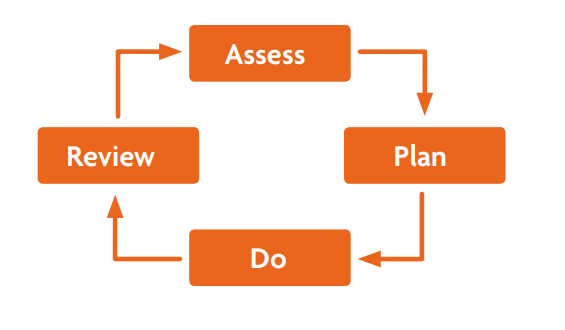
We will follow the trusts graduated approach and the four-part cycle of assess, plan, do, review.
The class teacher will work with the SENDCO to carry out a clear analysis of the pupil's needs. This will draw on:
- The teacher's assessment and experience of the pupil
- Previous progress, attainments and behaviour
- Other assessments where relevant
- The individuals’ development in comparison to their peers and national data
- The views and experiences of caregiver(s)
- The child’s views and experiences
- Advice from external support services, if relevant
All teachers and support staff who work with the pupil will be made aware of their needs, the outcomes sought, the support provided, and any teaching strategies or approaches that are required. This will be communicated through either:
- a Personalised Universal Provision (PUP)
- or an Individual Support Plan (ISP)
These documents will be shared with caregiver(s) each time they are reviewed (typically in term 2,4,6).
We will regularly review the effectiveness of the provision and their impact on pupil progress and engagement.
Supporting pupils moving between phases and preparing for adulthood
When children come into school through our nursery classes, a Key Worker for the child is identified. The Key Worker will meet with the parent and child at an initial visit so that information about the child including development, concerns, fascinations and home life can be exchanged. The child is then able to access settling-in sessions, which are short sessions and may be attended by the parents/carers. In these sessions the child will build up their relationship and trust with the Key Worker until Nursery and parents feel that the child is feeling secure and ready to be left on their own for short periods.
Before children’s entry into our Reception class, where a child has been identified as having additional needs, the Reception class teacher and Special Educational Needs and Disability Coordinator (SENDCo) meet Nursery Key workers, other professionals and parents/carers to discuss children’s strengths and areas of need. We also ensure that all previous records are sent to us.
Teachers hold transition meetings each year to share information with the child’s new class teacher.
We provided specific transition mornings for each year group team. This is facilitated and supported by ELAN Advisory team to ensure good provision is in place.
Transition for children to their new schools begins in the last term at Oldmixon. Teachers, SENDCo's and support staff meet to discuss children and their needs. All children meet staff from their new school at Oldmixon and when they attend a transition day at their new school.
Children who are identified as having additional need will have extra visits to their new school and meetings will be held to discuss their needs with key staff. Parents/carers and children are fully involved in these meetings. The number of visits and the time to start transition will vary according to each child’s individual needs.
Our approach to teaching pupils with SEND
We are committed to providing a broad and balanced curriculum, which is adapted to ensure that all children in our care have equal access to it. We teach our children in a way they will remember.
All teachers are teachers of all children and are responsible and accountable for the progress and development of all the pupils in their class.
High quality, inclusive, teaching is our first step in responding to children who have a special educational need. This will be adapted to meet the needs of individual children.
Provision for ALL children
• Classrooms are well laid out and all resources are clearly labelled.
• Daily routines are established early to enable children to be independent in the classroom.
• Children are given opportunities to work independently and with learning partners.
• There are regular opportunities for group and partner discussions in the lesson.
• All teachers have high expectations of every child and all is built on what your child already knows, can do and understand.
• Teachers carefully track your child’s progress at regular intervals to ensure that they are accessing the learning – small adaptations are made to further support if needed.
• The contributions of every child are valued and we provide a secure, supportive learning environment.
• We operate a behaviour policy.
• Classroom displays celebrate children’s achievements.
• Children take part in PE lessons each week.
• Children will have the opportunity to attend forest school during a term.
Adaptations to the curriculum and learning environment
All teachers are provided with information on the needs of individual children so that they can plan the learning within our curriculum to ensure that all children are able to make progress.
Differentiation is made for groups and individuals according to need: for example, if a child has Speech, Language and Communication Needs, teachers will use simplified language and/or pictures to support them to understand new vocabulary.
Assistive Technology is used, when appropriate, to enable pupils with motor skills or communication difficulties to write with increased speed, accuracy and confidence.
When feasible, we make reasonable adjustments to improve the accessibility of our environment, including the curriculum and access to information. Our policy and practice adheres to The Equality Act 2010.
Where additional support or resources are needed, our SENDCo liaises with the relevant outside agencies and parents to ensure additional provision is in place.
Additional support for learning
In order to meet the individual needs of a child, the school regularly works with and seeks advice from other professionals such as educational psychologists, advisory teachers, health colleagues and our Extend Learning Academies Network (ELAN) colleagues.
We regularly invest time and money in training our staff to improve provision for all students and to develop enhanced skills and knowledge to deliver short term interventions and individualised interventions.
Our Special Needs and Disability Co-ordinator (SENDCo) is a qualified teacher with 15 years of experience in primary education and has secure knowledge and experience of developing provision for pupils with additional needs.
All our teachers hold qualified teacher status and all staff members, including TAs and HLTAs, receive regular training to best support our children with SEND. This takes place through staff meetings, INSET days, training courses and TA meetings.
We work with the following agencies to provide support for pupils with SEND:
- Education Mental Health Practitioner (EMHP)
- Speech and Language Therapy
- Occupational Therapy
- Physiotherapy
- School Nursing Team
- Education Psychology
- Community Paediatrics
- Children’s services
- North Somerset Inclusion Panel
- Children and Adolescent Mental Health Services (CAMHS)
- ELAN SEND Lead Practitioner.
Securing equipment and facilities
Support is allocated according to need.
Specialist equipment, adaptations to the classroom and extra adults to enhance ratios are initially secured through the school’s budget.
Decisions about support are individual and based on the child’s needs and what the school can
be reasonably expected to provide without causing detriment to other children’s learning. We are always happy to discuss with parents / carers the support that their child is getting and to explore any changes that we might be able to make to support their child’s needs.
When a child requires a high level of extra support, further assistance may be accessed through the local authority. This involves the school making an application to the local authority for an EHCP which may result in additional funding to enhance provision.
Evaluating the effectiveness of SEN provision
Our Special Educational Needs and Disability Coordinator (SENDCo) is Lindsay Avci. Lindsay works closely with parents/carers, class teachers, senior leaders and outside agencies to coordinate support for children with additional needs.
The SENDCo will:
• oversee and coordinate additional provision
• be an additional point of contact to discuss concerns with parent/carers, children and staff
• arrange review meetings which include children/young people, their families and involved professionals
• liaise with professionals from outside agencies
• arrange and carry out annual reviews for children with EHCPs and will complete the annual review paperwork.
• ensure that transition is managed effectively when children move between classes or schools.
We evaluate effectiveness of provision for pupils with SEND by:
- reviewing pupils progress towards their targets (terms 2, 4, 6)
- holding annual reviews for pupils with EHCPs
- using pupil and caregiver feedback via questionnaires, conferencing or review meetings
- reviewing the impact of intervention
- discussion of progress through Pupil Progress meetings
- monitoring by the SENDCo and Senior Leadership Team
Enabling pupils with SEN to engage in school activities together with their peers
Our culture of inclusion promotes involvement of all our learners in all aspects of the curriculum
including activities outside the classroom. We make reasonable adjustments so that learners can join in activities regardless of their needs.
Where there are concerns of safety and access, further thought and consideration is put in place to ensure needs are met when possible, through reasonable adjustment and where applicable parents/carers are consulted and involved in planning.
Additional staff may accompany the children on field trips to ensure all can participate.
When feasible, we make reasonable adjustments to improve the accessibility of our environment. Our policy and practice adheres to The Equality Act 2010.
Support for improving emotional and social development
All children are supported with their social and emotional development throughout the school day, through the curriculum and extra-curricular activities. For example: Personal, Social and Health Education (PSHE) through the Jigsaw scheme of work, ‘check-in’ sessions with familiar adults or social skills groups.
Our Behaviour and Relationships Policy includes guidance on expectations, rewards and sanctions and helps us to embed a positive culture that promotes excellent behaviour.
We have teaching assistants on the playground at play and lunch times to provide a continuity of support for children and to support their social interactions.
We regularly monitor attendance, support children returning to school after absence and take the necessary actions to prevent prolonged unauthorised absence. We have regular meetings with the Education Welfare Officer (EWO).
Relevant staff are trained to support medical needs. We have a medical policy in place and every classroom has a list of children with medical needs.
Children’s views are central to our ethos and are sought individually or through pupil conferencing and other forums.
All staff have received up-to-date safeguarding and Prevent training.
Working with other agencies
The school works closely with many outside agencies to ensure all children are supported fully. Parents/carers are consulted and written consent is sought as required.
We seek to respond quickly to emerging need and work closely with other agencies including:
- Education Psychology
- Community Paediatricians
- Enhanced Provision for Social Communication and Autism
- Occupational Therapy
- Speech and Language Therapy
- School Nursing
- Vision Support
- Hearing Support
- Child and Adolescent Mental Health Services (CAMHS)
- Virtual School
- North Somerset Early Help
- ELAN SEND Practitioner
- SENDIASS (Special Educational Needs and Disability Information, Advice and Support Service)
Complaints about SEN provision
If you have a concern regarding the educational provision for your child(ren) or any special educational need, then please contact the class teacher or SENDCo in the first instance. We will endeavour to listen and work collaboratively to answer any questions and resolve any difficulties.
Should this route prove unsatisfactory, then a complaint should be made in accordance to the ELAN Complaint Procedures found on our website.
The local authority Local Offer
North Somerset SEND Hub (Local Offer)
Contact details of support services for parents/caregivers of pupils with SEN
Family hubs (previously Children’s Centres)
Additional information about SEND
You know your child better than anyone else. If your child is already in school (including nursery or preschool) and you have concerns or think your child needs additional support, please talk to their teacher initially.
The school's Special Needs Coordinator (SENDCo) Lindsay Avci, organises provision for children with SEND. If you would like to get in touch with Lindsay Avci, please contact the school office.
What is our SEND provision?
We recognise each child as a unique individual with his or her own personal talents, experiences, learning styles and needs. We value their abilities and achievements, and are committed to providing an effective learning environment which promotes their intellectual and personal development. We are an inclusive school - we wish to see children of all abilities, talents and disability educated together. We aim to enable all children to participate fully in school life.
We understand the positive benefits that inclusion brings, enriching and strengthening our community. Where children have additional needs the whole school community is committed to supporting them. All teachers at Oldmixon are teachers of ALL children. We seek to support all children's access to the curriculum so that they have the opportunity to progress and achieve success. We strongly believe in involving the children and you as their parent/carer in a positive working partnership with us.
Who is involved with your child?
Your child's teacher:
- checks on your child's progress, identifies, plans and delivers any additional help your child may need
- plans for all children who need extra help
- monitors this help to make sure it is making a difference for your child with permission
- ask for further specialist help
- discusses with you at all stages how your child is doing, what help and support is needed and together agreeing plans and reviews of how things are working
- in partnership with parents/carers sets targets for your child.
How does the school make provision for pupils with additional needs with or without an EHC plan?
We provide support for children in many different ways. Some children’s needs will be met by adapted work or small group work with adult support. At times some children may need 1:1 support from a teaching assistant (TA) to help them access their learning. Where necessary children may have a personalised curriculum which suits their learning needs.
The Graduated Response:
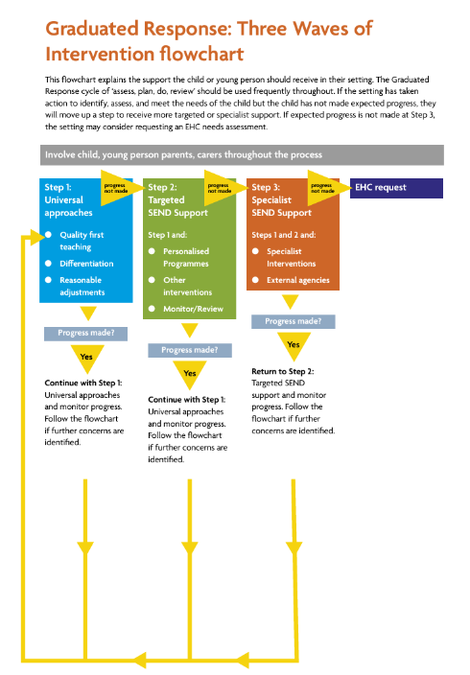
What is the Graduated Response? The SEND Code of Practice 2015 states that children and young people with SEND should have their needs met and outcomes achieved in a mainstream education setting; however, it also acknowledges that a specialist provider may be another option for a few children and young people.
A key principle of the Code of Practice is that the views, wishes, and feelings of the child or young person and their parent/carers should inform the support they receive. This begins with making sure they are provided with all the information and support they need to feel confident and participate fully in decisions about their support.
The Graduated Response expects mainstream providers to make full use of all their resources and expertise before accessing increasingly specialist support provision. The Graduated Response follows four stages of action: Assess, Plan, Do, Review, as outlined in the SEND Code of Practice.
What is high quality inclusive teaching?
High quality inclusive teaching means.
- The teacher has the highest possible expectations for your child and all pupils in their class
- All teaching builds on what your child already knows, can do and understand
- Lessons are appropriately differentiated or adapted which means different ways of teaching are in place so that your child can access the lesson and is fully involved in their learning. Some examples of differentiation are: additional resources to support their learning, opportunities for paired work or small group work, different ways of presenting their work
- Specific strategies (suggested by the SENDCo) to support your child to learn
- On-going assessment within the day-to-day framework of the classroom of your child’s progress to identify any gap or gaps in their understanding/learning
All children have access to high quality inclusive teaching, but where a potential additional need has been identified, the approach to your child’s teaching and learning becomes increasingly personalised as our understanding of your child and his/her need grows. Thus, support becomes more targeted.
What is an Individual Support Plan (ISP)?
Individual Support Plan (ISP)
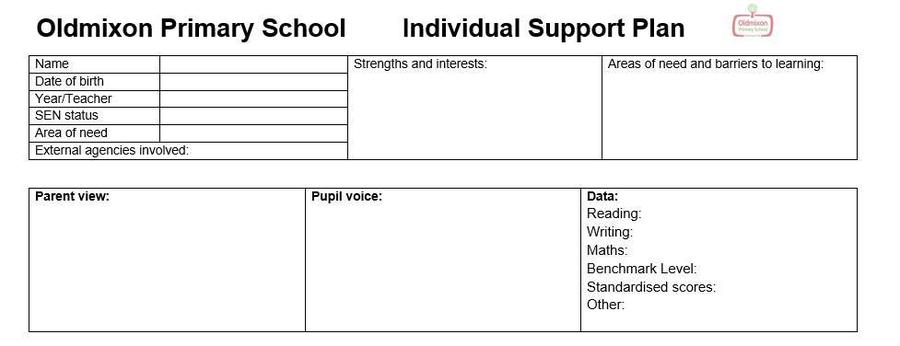
Some children who receive more long term support will be on the school’s SEN register. Parents will be informed of this. Your child may have an individual support plan created for them which outlines their needs and support that they will receive in school. On the plan, we implement short-term, medium-term and long-term outcomes for the child, giving them achievable and aspirational outcomes to work towards whilst at Oldmixon. The content of the ISP is negotiated, as appropriate, with the class teacher, child and child's family, with a focus on the progress of 'Assess, plan, do, review.'
The ISP is reviewed three times a year with the parent, the class teacher and the SENDCo. This is where we will review the outcomes for the child and plan for next steps to further their progress. We shall also look at their strengths and barriers to learning and parent and child views as it is important to take on board external factors when reviewing these plans.
If you do have any questions about the plan, please do contact your child's class teacher, or the SENDCO - Mrs Avci.
What are the arrangements for supporting children who are looked after by the local authority and have SEND?
Mrs Amanda Martin is our designated person with responsibility for Children Looked After (CLA). She will attend Personal Education Plan (PEP) meetings, PEP reviews and liaise closely with the Virtual School. Mrs Amanda Martin and Mrs Lindsay Avci (SENDCo) will liaise to oversee provision that is put into place to support the child’s special educational need and will attend child progress meetings and reviews.
Speech, Language and Communication
A child naturally acquires language from a very early age and goes through a recognised pattern of learning vocabulary, sentences and concepts to be able to communicate verbally. Add to this speech sound processes, attention and social development and you realise how complex communication is.
When this natural process diverges from the normal pattern, e.g. when a child has difficulty with grammar or speech sounds, poor listening or stammering, it is called a speech, language and communication difficulty.
We are in the fortunate position to be able to offer targeted speech and language provision on site from a specially trained speech and language assistant - Mrs Beth Brown.
We work with outside agencies to deliver 1:1 speech and language programmes as well as designing group activities that will cater to children's specific needs.
Our Speech and Language provision also includes delivery of intervention programmes. This includes Talk Boost which is a target intervention for children in Reception, KS1 and KS2 focused on narrowing the language gap between them and their peers.
Motor Skills
To support children with physical needs, we use Smart Moves. This is a programme full of fun activities and games to encourage children with motor coordination difficulties to succeed. Through this programme, we create a simple, effective tailored programme for each child.
Pastoral Support
Our Learning Mentors - Mrs Dawn Palfrey and Miss Chloe Daniels are available to meet with parents to discuss any social and emotional issues which they feel may be affecting their child’s ability to learn. They can work with small groups and/or with individual children depending on the child’s specific needs. Appointments can be arranged via the school office.
What resources or programs do we use to support our children in school?
- Over the last 2 years we have had staff in every key stage trained to deliver and support speech and communication needs in our school.
- All classroom use visual timetables and prompts to help support routines and develop clear expectations.
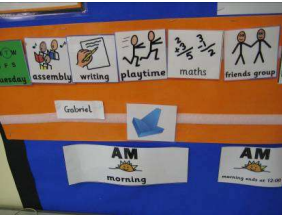
- We use a practical resources to support all learning where possible. We have wealth of resources available in every classroom.